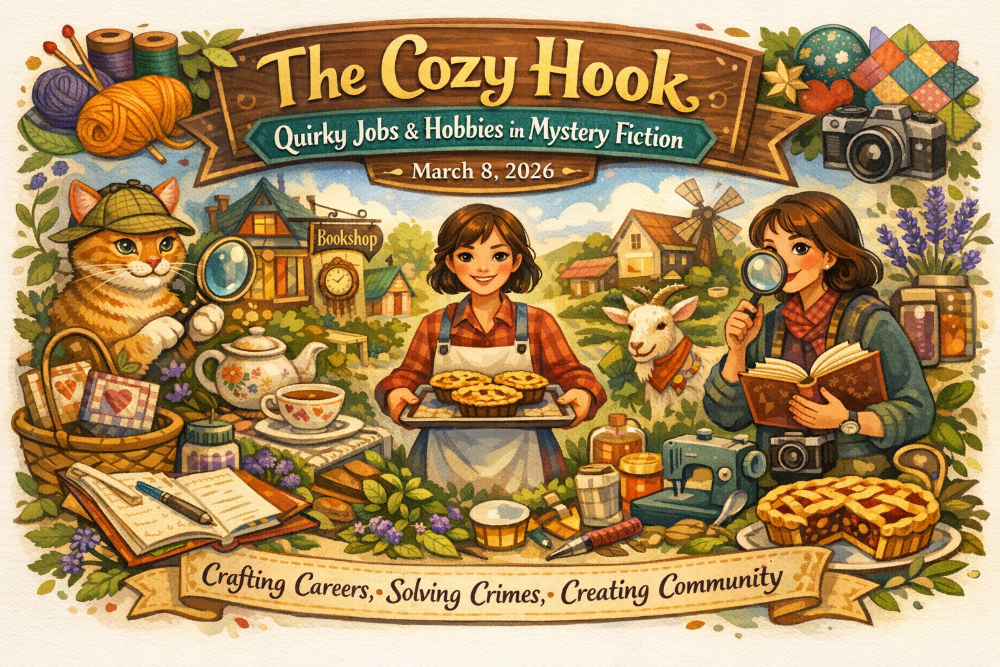
The Cozy Hook: Quirky Jobs & Hobbies in Mystery Fiction
Why your protagonist’s unusual vocation is more than a charming detail — it’s the engine of your whole story.
Pick up almost any cozy mystery and you’ll find it within the first few pages: a protagonist who owns a herb farm, bakes prize-winning pies, repairs antique clocks, or teaches goat yoga. This is no accident. In cozy fiction, the hero’s quirky job or hobby isn’t merely a charming backdrop — it’s the beating heart of the story.
What draws readers to cozy mysteries isn’t primarily the murder (though that certainly helps). It’s the world. The warm, specific, lovingly detailed world that only someone with a particular expertise could inhabit. When you crack open a cozy set in a Welsh wool shop or a Southern barbecue competition, you’re signing up for vicarious immersion in a life that feels both comfortably ordinary and deliciously specialized. The quirky occupation is the promise on the cover — and keeping that promise is what turns casual readers into devoted fans.
So why do these unusual vocations work so well, and how can you wield yours to its full potential? Let’s dig in.
The Double Duty of a Specialized Protagonist
A well-chosen occupation or hobby pulls double duty in a cozy mystery. First, it does the world-building work: it tells us where we are, who surrounds the protagonist, and what textures fill their daily life. Second — and this is the part many newer writers underuse — it actively drives the plot. The best cozy hooks don’t just flavor the story; they enable it.
Consider The No. 1 Ladies’ Detective Agency series by Alexander McCall Smith. Precious Ramotswe’s career as Botswana’s only female private detective isn’t just a charming premise; her role as a shrewd, culturally embedded observer of human behavior is the mechanism by which every mystery gets solved. Or think of Diane Mott Davidson’s caterer Goldy Schulz: the catering business brings Goldy into the private spaces of wealthy families, overhearing arguments, noticing missing silverware, reading a room the way only someone who has served hundreds of dinner parties can.
The job creates access. Access creates opportunity. Opportunity creates story.
Real-World Examples That Get It Right
The Cat Who… Series — Lilian Jackson Braun Newspaper journalist Jim Qwilleran and his Siamese cats crack cases by tapping into the gossip networks and social rituals of small-town life. Journalism gives him a legitimate excuse to ask anyone anything.
Flipped for Murder — Maddie Day Country store owner Robbie Jordan runs a breakfast restaurant in rural Indiana. Recipes appear throughout; the food community creates a natural web of suspects, rivalries, and loyalties.
The Agatha Raisin Series — M.C. Beaton Retired PR executive Agatha brings her sharp eye for spin and reputation to every case. Her background explains both her social confidence and her occasional blundering into danger.
The Needlecraft Mysteries — Monica Ferris Betsy Devonshire runs a needlework shop in a Minnesota lake town. The hobby world provides a tight-knit community of regulars who gossip, argue, and occasionally commit crimes.
Knit One, Kill Two — Maggie Sefton The Lambspun yarn shop in Fort Connor, Colorado is more than a setting — it’s the information hub of the town, where knitters gather, unravel both wool and secrets.
Death by Darjeeling — Laura Childs Theodosia Browning’s Charleston tea shop puts her at the center of upscale Southern society events — fundraisers, garden parties, antique shows — all prime murder territory.
Why Niche Worlds Create Better Mysteries
There’s a craft reason why the niche matters so much: it determines the texture of your clues. A gemologist protagonist notices the fake diamond in the victim’s ring. A pastry chef recognizes that the poison was masked in a specific ganache. A competitive orchid grower knows exactly which rare species was missing from the greenhouse and who might have stolen it. Expertise transforms ordinary observations into incriminating details that only your protagonist — and your reader, vicariously — would catch.
This is what separates a cozy with a genuine hook from one that merely slaps a profession in the title. In the latter, the job is decoration. In the former, it’s a lens. Your protagonist sees the world differently because of what they know, and that difference is what makes them the right person to solve this particular murder in this particular place.
The Community Factor
Niche occupations also generate communities — and cozy mysteries run on community. A bookshop owner draws in literary types, local eccentrics, and the occasional rare book thief. A dog trainer works with a rotating cast of pet owners from every walk of life. A competitive county fair baker is embedded in a world of intense amateur rivalries, secret recipes, and decades-old grudges. These built-in casts of recurring characters give readers the sense of inhabiting a real place with a real social ecosystem.
The community also solves one of mystery writing’s trickiest problems: plausible access. Why would an ordinary person keep stumbling across murders? Because they’re not ordinary — they’re the hub of a specific social wheel, and things happen around hubs. A florist delivers to every important event in town: funerals, weddings, hospital rooms, and gala dinners. Of course she ends up adjacent to trouble.
Picking Your Hook: What Makes One Stick?
Not all quirky occupations are created equal. The best cozy hooks share a few key characteristics. They create natural access to a world where crime might plausibly occur. They supply the protagonist with specific, transferable expertise that helps solve cases. They generate a recurring cast of characters with different relationships to that world. And — perhaps most importantly — they genuinely interest the author.
That last point matters more than writers expect. If you find competitive axe-throwing genuinely fascinating, your readers will feel that enthusiasm on every page. If you chose a cheese shop purely because it sounded whimsical, the research will feel thin and the world will feel hollow. The best cozy writers are usually writing about something they actually love.
✦ Questions to Test Your Hook’s Strength
- Does this occupation or hobby naturally put my protagonist in contact with a variety of people, including potential suspects?
- What specific knowledge does this world give my protagonist that a police detective would lack?
- Can I sustain a series in this world — is there enough variety, enough recurring characters, enough seasonal or event-driven drama?
- Does the setting have a physical space that readers will want to return to (a shop, a studio, a competition circuit)?
- Is there a rich subculture here — jargon, rivalries, insider knowledge — that will reward engaged readers?
- Am I genuinely excited to research and write about this world for potentially a dozen or more books?
Turning the Hobby into a Plot Engine
Once you’ve chosen your hook, the real craft challenge begins: weaving it so tightly into the mystery that removing it would cause the plot to collapse. This is the difference between a job that’s mentioned and a job that matters.
Try this exercise: take the central crime in your story and ask, “How does my protagonist’s specific expertise help solve it — in a way no one else could?” The answer should be concrete. A vintage clothing dealer recognizes that the “antique” brooch found near the body was made with a synthetic material that didn’t exist until 1962, which blows the suspect’s alibi. A competitive chess player notices that the blackmail letters were structured in Sicilian Defense patterns, suggesting the writer has a chess background. A forager recognizes the distinctive staining left by a particular toxic mushroom on the victim’s fingertips.
The more precisely your protagonist’s knowledge intersects with the crime, the more satisfying the revelation will feel. It rewards readers who have been paying attention to the craft details all along — and those readers become the loyal fans who buy every book in the series.
Seasonal Arcs and Event-Driven Plots
Another advantage of niche worlds: they come with built-in dramatic calendars. A bakery cozy has holiday rushes, county fair competitions, and wedding cake commissions. A garden center mystery has spring planting season, summer tours, and the pressure of a flower show. These seasonal rhythms give each book in a series a natural distinct identity while keeping the protagonist and setting consistent. They also supply ready-made set pieces — the chaos of a baking competition is a naturally tense environment in which secrets might come spilling out.
The Cozy Contract
At its deepest level, the quirky job or hobby is part of what scholars call the “cozy contract” with readers: the implicit promise that this book will deliver not just a puzzle, but an experience. An experience of warmth, of community, of a world that feels safe even as it accommodates murder. The protagonist’s occupation is the hand extended to the reader at the door — come in, let me show you around, you’re going to love it here.
When that world is richly imagined, accurately researched, and genuinely beloved by its creator, readers don’t just solve the mystery. They move in. They start checking the bookshelf for the next installment before they’ve finished the last chapter. They recommend the series to friends with a specific elevator pitch: “It’s set in this amazing wool shop in the Cotswolds, and the owner keeps stumbling into murders, and you learn so much about weaving…”
That’s the cozy hook at its most powerful. Not a gimmick. Not a marketing angle. A whole world, made possible by one person’s very specific, very peculiar expertise.
Your protagonist’s quirky vocation isn’t a costume to dress up a generic detective. It’s a filter, a community, a set of keys to rooms that would otherwise stay locked — and in the right hands, it’s the reason readers will follow your sleuth through a dozen books without ever growing tired of the world you’ve built.



One Comment
Pingback: