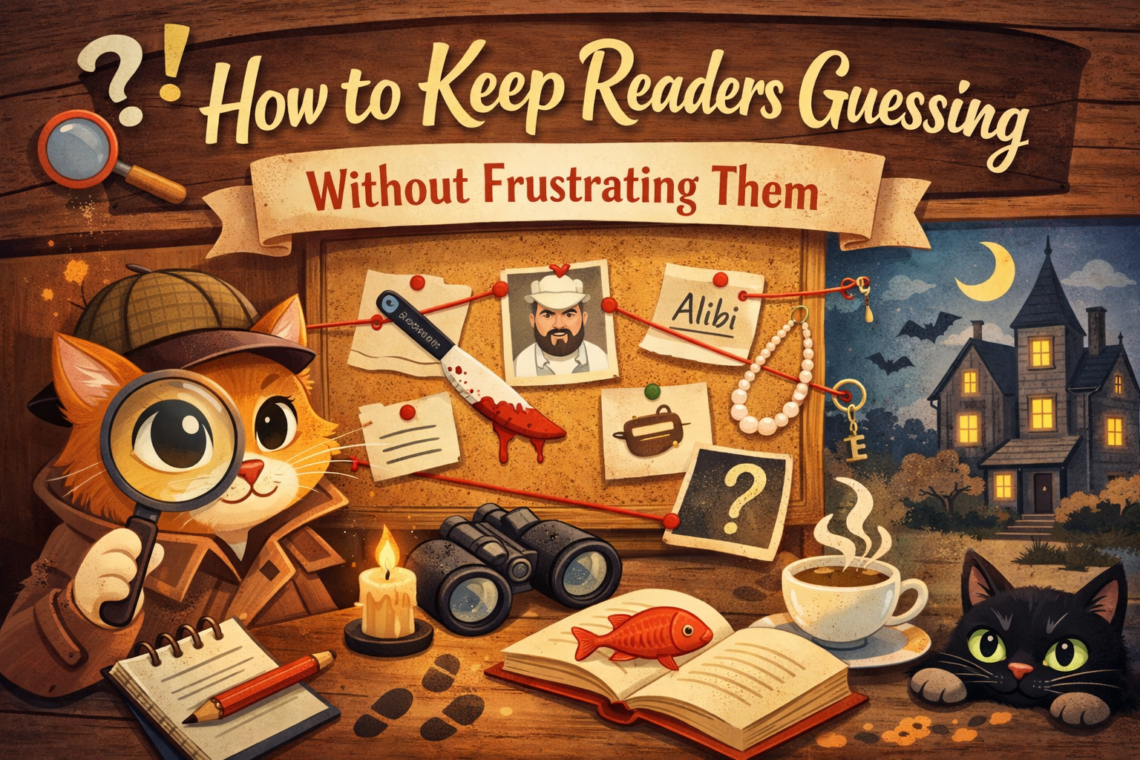
How to Keep Readers Guessing Without Frustrating Them
Red herrings are one of the most satisfying tools in a cozy mystery writer’s toolbox—when they’re done well. When they’re not, they’re the fastest way to make a reader feel tricked, annoyed, or worse… disengaged.
The goal isn’t to fool your reader. It’s to guide them down the wrong path in a way that feels completely fair—so when the truth is revealed, they smile and think, “I should have seen that.”
Let’s break down how to do exactly that.
What a Red Herring Really Is (and Isn’t)
A red herring isn’t just a random false clue tossed into the story.
It’s a plausible, story-driven misdirection.
That means:
- It makes sense within the world of your story
- It aligns with character motivations
- It could genuinely point to the wrong suspect
A bad red herring feels like manipulation.
A good one feels like truth—just not the truth.
The Golden Rule: Play Fair With the Reader
Cozy mystery readers expect a fair game. They want to solve the puzzle alongside your sleuth.
If you hide key information or introduce misleading clues that couldn’t reasonably be interpreted, readers feel cheated.
Instead:
- Show the clue clearly
- Let it be interpreted in more than one way
- Allow the reader to draw the wrong conclusion naturally
Example:
A baker argues loudly with the victim the night before the murder.
- Bad version: The argument is exaggerated or misleading, but later revealed to be about something trivial never hinted at.
- Good version: The argument is real—but it’s about a stolen recipe, not murder.
Same clue. Different execution. One builds trust, the other breaks it.
Tie Every Red Herring to Character Motivation
The strongest red herrings come from people, not plot tricks.
Every suspect should have:
- A believable reason to lie
- Something to hide
- Behavior that can be misinterpreted
When your sleuth uncovers secrets, they should look like motives—even if they aren’t.
Example red herring motivations:
- A shop owner is hiding financial trouble
- A friend is covering up an affair
- A local official is protecting a scandal
None of these equal murder—but all of them can convincingly point in that direction.
Layer Clues and Misdirection Together
A single red herring won’t carry your mystery. You need layers.
Think in terms of:
- Real clues (point to the killer)
- Red herrings (point elsewhere)
- Neutral details (world-building and texture)
The key is balance.
If everything is suspicious, nothing is.
If only one thing is suspicious, the mystery is too easy.
Tip:
For every real clue, consider adding one misleading interpretation that points to a different suspect.
Use Timing to Your Advantage
When you reveal information matters just as much as what you reveal.
Well-placed red herrings often:
- Appear right after a major clue
- Distract from something important
- Gain significance later when reinterpreted
Example flow:
- Sleuth finds a threatening note (real clue)
- Immediately discovers a suspect with a temper (red herring)
- Reader connects the wrong dots
By the time the truth comes out, the reader realizes the note meant something entirely different.
Let Red Herrings Pay Off
Even though they mislead, red herrings shouldn’t feel pointless.
Each one should:
- Reveal character depth
- Add tension or conflict
- Move the story forward
If a clue leads nowhere and adds nothing, it feels like filler.
But if that same clue exposes a secret, creates a confrontation, or deepens relationships—it earns its place.
Avoid These Common Red Herring Mistakes
- The “Out of Nowhere” Twist
If the truth couldn’t have been guessed, readers won’t feel satisfied. - Overcomplicating the Plot
Too many twists create confusion instead of intrigue. - Making Everyone Suspicious All the Time
Suspicion loses impact if it’s constant. - Dropping Threads
If you introduce a misleading clue, resolve it. Loose ends frustrate readers.
A Simple Formula You Can Use
When plotting your cozy mystery, try this:
- Give each suspect:
- 1 believable motive
- 1 secret (red herring)
- 1 suspicious moment
- For your actual culprit:
- Hide the real motive among smaller truths
- Let their behavior seem less suspicious than others
- Plant clues that only make sense in hindsight
This creates a mystery that feels layered—but still fair.
Final Thought: Confusion Isn’t the Goal—Curiosity Is
The best cozy mysteries don’t overwhelm readers. They invite them to participate.
A strong red herring doesn’t make readers feel lost.
It makes them lean in closer.
So instead of asking, “How can I trick my reader?”
Ask, “How can I make this clue believable in more than one way?”
That’s where the magic happens.
Happy Writing!
Patti Ann
Grab the free cheatsheet below:


You May Also Like
7 Plot Hooks That Instantly Grab Readers in Cozy Mysteries
5 Mistakes That Make a Cozy Mystery Flat — And How to Fix Them